
SMSF Crypto Tax: How Much You'll Pay (and How to Cut It)
How to benefit from as little as 0% tax on your SMSF's crypto without the ATO breathing down your neck.
In this article
- How is crypto taxed in an SMSF?
- How much tax will you actually pay?
- Safekeep Case Study: A $28,000 tax bill on income that should have been tax-free
- What triggers crypto tax in an SMSF?
- How to pay less, legally
- Division 296 and the “Bitcoin is exempt” myth
- Why hold crypto in an SMSF at all?
- Are the SMSF crypto tax rules changing?
- Myths that cost SMSF trustees money
- The records you must keep (and the penalties if you don’t)
- The bottom line
- Frequently Asked Questions about SMSF crypto tax
Nobody wants to pay more tax than they need to. Same for your crypto SMSF.
Here’s the good news, up front. Held the right way, an SMSF is one of the lowest-taxed legal structures for crypto in Australia. Your gains are taxed at 15% in accumulation phase, about 10% if you hold for more than a year, and as little as 0% once you’re in pension phase up to a certain amount, compared with up to 47% if you held the same crypto in your own name.
But the rate is only half the story. What trips people up is when the tax is triggered, and the traps that turn “I made three trades” into a page of tax events. This guide gives you the numbers, the triggers, and the legal levers to pay less. Everything here is about planning and paying what you need to, not a cent more.
But be warned. The SMSF is the last clean low tax vehicle in Australia. The government will do everything in its power to extract from you. And in the worst case, enforce confiscation. So you must set it up so you have control of your assets.
How is crypto taxed in an SMSF?
Inside an SMSF, crypto is taxed like any other investment asset, and the rate depends on the stage your fund is in and how long you hold the asset. In accumulation phase, gains are taxed at 15%. Hold the crypto for more than 12 months and a one-third discount applies, so the effective rate drops to about 10%. In pension phase, the rate can be 0%.

The same applies to Bitcoin, the most common crypto an SMSF holds: its tax follows exactly these rules.
Here’s the point most people get wrong. They assume a super fund gets the 50% CGT discount. It doesn’t. According to the ATO, a complying fund gets one-third, and only on assets held for at least 12 months (section 115-100 of the Income Tax Assessment Act 1997).
One caveat on that 0%: if only part of your fund is in pension phase, only that part’s share of the earnings is tax-free.
To see how a crypto allocation behaves as your fund moves through each stage, from building it to drawing it down, read our guide to crypto across the SMSF lifecycle.
Compare that to holding crypto yourself. As an individual you’re taxed at your marginal rate, up to 47% with the Medicare levy. That’s why the SMSF is one of the most tax-efficient vehicles in Australia.
How much tax will you actually pay?
On a $50,000 gain, you’ll pay about $7,500 in accumulation, roughly $5,000 if you held it over 12 months, or $0 in pension phase. Here’s the same gain run through the three stages.
| Your situation | The maths | Tax |
|---|---|---|
| Sold within 12 months, accumulation | $50,000 x 15% | $7,500 |
| Held over 12 months, accumulation | one-third off, $33,333 x 15% | $5,000 |
| In pension phase (within the cap) | earnings support your pension | $0 |
For comparison if you held the asset in your own name and are on the top marginal rate, the long-term version of that gain would cost about $11,750 (half the gain taxed at 47%). That gap is why the structure is worth understanding.
Capital losses help here too. They offset capital gains only, not the fund’s other income, and any unused loss carries forward to future years. You net your gains against your losses first, then apply the discount.
What triggers crypto tax in an SMSF?
The biggest myth in crypto tax is that you’re only taxed when you cash out to dollars. Tax applies when you dispose of crypto or earn it, not when the money hits your bank account. Several everyday actions are disposals, and most trustees miss them. The ATO makes sure every nook and cranny is covered for them to extract tax from you.
Swapping one crypto for another
This is the big one. According to the ATO, trading Ethereum for Bitcoin is a sale of the Ethereum, taxed in Australian dollars, even though you never touched cash. Think of it like selling an investment property in Melbourne to buy one in Sydney: the tax office wants its slice of the Melbourne sale.
Spending crypto, or paying fees with it
Spending crypto on goods or services is a disposal, at the value on the day you spend it. Paying network or “gas” fees in crypto is a disposal too, of the asset used to pay the fee. A trustee with “no trades” can still rack up dozens of small tax events this way.
Wrapping or bridging an asset
Wrapping or bridging an asset (for example Bitcoin to wrapped Bitcoin) is treated by the ATO as a disposal. That view rests on ATO guidance rather than a binding ruling, and some tax specialists dispute it, so the safe assumption is that it triggers tax.
Staking rewards and airdrops
These are taxed as income the day the fund receives them, before you sell anything. Staking has its own rules and its own catch, covered in crypto staking in an SMSF.
As you can see the burden of proof creates a high compliance cost. You have to dance like a monkey just to prove your money is yours so the ATO doesn’t penalise you. What a world we live in. But that’s why SMSFs aren’t for everybody.
One point that saves confusion: moving crypto between two wallets your fund owns is not a disposal, because ownership hasn’t changed. But if you pay a fee to do it, that fee is.
Crypto is a CGT asset, confirmed by the Australian tax office, not foreign currency. So the ordinary capital gains rules apply, the same as shares or property. This assumes your SMSF holds crypto as an investment. A fund that trades actively is carrying on a business, so it is taxed differently, with no discount, which is a separate question and another rabbit hole.
How to pay less, legally
You can lower your bill without going near a line you shouldn’t cross. The levers are simple, and they’re all about timing and structure.
- Hold for more than 12 months for the easiest win: it unlocks the one-third discount.
- Realise gains in pension phase, where the earnings on those assets can be taxed at 0%, within your transfer balance cap.
- Time your disposals: a sale on 2 July instead of 28 June pushes the gain into the next financial year, which can change when the tax falls due and let you pair it with losses.
- Harvest losses in the same year as a gain to reduce the taxable amount, remembering that losses must be realised to count.
- Balance across spouses, which matters more than ever now that large balances attract extra tax (see Division 296 below).
- Keep cash aside for the tax on a big gain before you reinvest, so a later price fall doesn’t leave the fund owing money it no longer has.
That last one sounds obvious, and it’s the one that hurts people if the market conditions go against them. The fund owes tax on the gain you realised, even if you’ve since rolled the money into another asset that dropped.
Division 296 and the “Bitcoin is exempt” myth
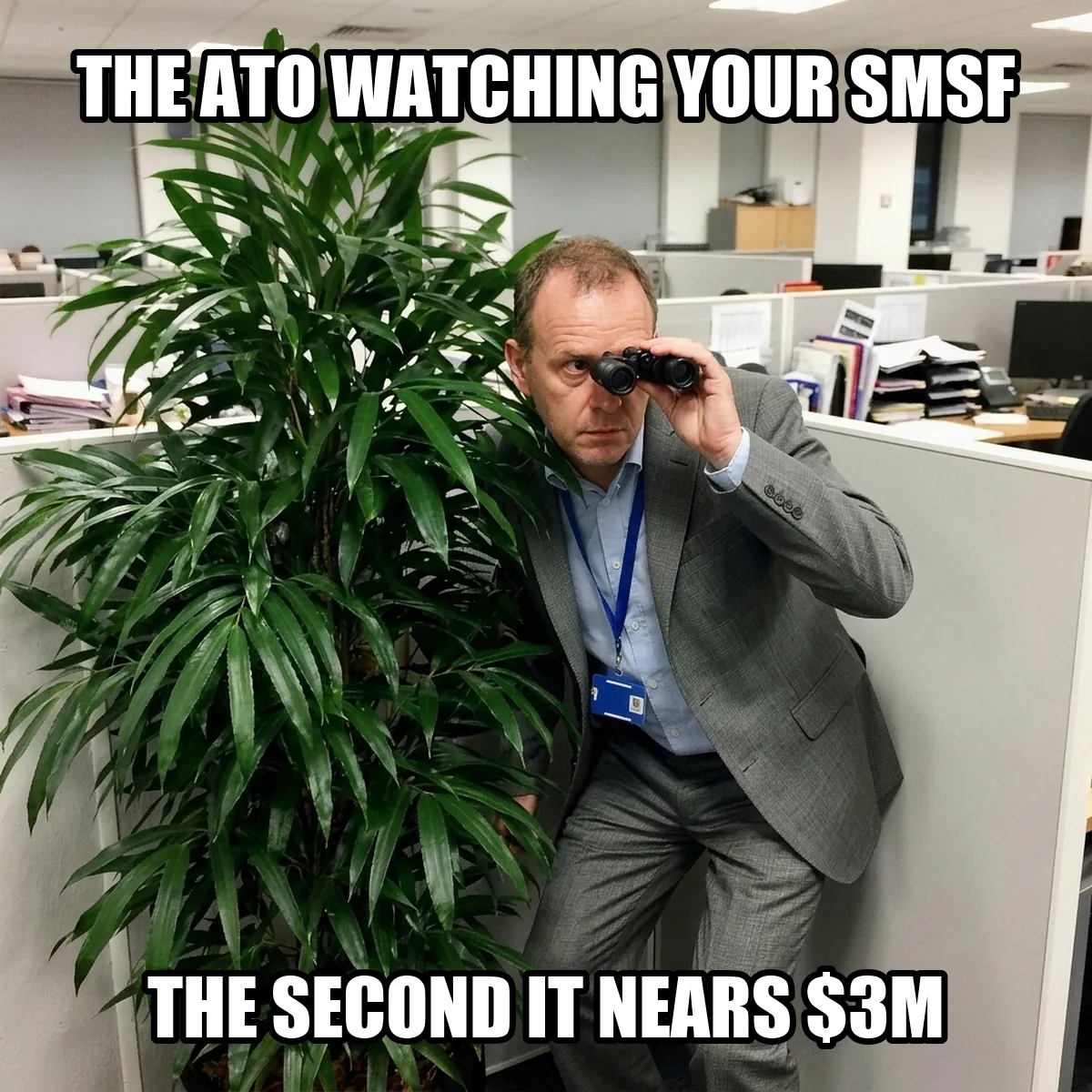
From 1 July 2026, Division 296 adds an extra 15% tax on the earnings from the part of a member’s super balance above $3M. Balances above $10M are taxed more again. It’s now law, it taxes realised earnings (not paper gains), and both thresholds are indexed. Crucially, it’s a balance test (a share of those earnings, not a flat charge), so no asset is carved out. So the idea that Bitcoin sits outside Division 296 is wrong.
If your fund is nowhere near $3M, this doesn’t touch you yet. If it’s approaching that line, the planning matters, especially the liquidity to pay the bill without a forced sale. We cover the crypto-specific detail, the worked numbers, and the levers in tax when your crypto SMSF hits $3M.
You just have to know, if you hold crypto through a rally and you gain more than 3 million balance, the ATO is going to rub their grubby fingers together and watch you like a hawk.
Why hold crypto in an SMSF at all?
Because on tax alone, the SMSF is hard to beat compared to other Australian entities. Here’s the same crypto gain across the vehicles you could use.
| Vehicle | Short-term (under 12 months) | Long-term (over 12 months) | CGT discount |
|---|---|---|---|
| SMSF, accumulation | 15% | about 10% | one-third |
| SMSF, pension phase | 0% | 0% | exempt |
| Held personally | up to 47% | about 23.5% at the top rate | 50% |
| Company | 25% or 30% | 25% or 30%, no reduction | none |
| Family trust | beneficiary’s rate | flows through, 50% to individuals | 50% (flows through) |
Pension-phase 0% applies within your transfer balance cap. The SMSF wins on rate. It isn’t free, though. Your money is locked in until you meet a condition of release, you carry annual compliance and audit costs, and contribution caps limit how much you can move in. That trade, lower tax for less access, is the real decision. For the full head-to-head, see crypto in an SMSF vs holding it personally and direct crypto vs a crypto ETF.
Are the SMSF crypto tax rules changing?
If you haven’t noticed, Australia is going through some political divides. Crypto and super rules have shifted a lot lately, and more is proposed. You can always assume changes will be in favour of the ATO, not you. It’s a reason to hold your crypto in a structure that you control and can’t be confiscated by the government.
Two changes worth knowing. First, from 1 July 2027 the 50% CGT discount for assets held outside super is being scrapped, replaced by cost-base indexation plus a minimum tax. This is now law: it passed in June 2026, though it doesn’t start until 1 July 2027, so individuals still get the 50% discount for now. The key point for you: super is excluded, so an SMSF keeps its concessional treatment. That means the gap between holding crypto personally and holding it in super is set to widen, not narrow.
Second, the tax office now sees far more than it used to. It’s not just a tax change, it’s a tracking change. The ATO’s crypto data-matching program has run since 2019, and it reaches back to the 2014-15 financial year, pulling wallet addresses and linked bank accounts. From 2027, global reporting frameworks widen that further. The lesson is plain: keep clean records, and let a compliant structure do the work.
Myths that cost SMSF trustees money
| The myth | The truth |
|---|---|
| The 50% CGT discount applies in super | No. In super it’s one-third, not 50%. |
| You’re only taxed when you cash out to dollars | No. Any disposal is taxed, including swapping one asset for another and spending crypto. |
| Stablecoins aren’t taxed | Disposing of a stablecoin is still a CGT event. The gain is often small, though a US-dollar stablecoin can move with the exchange rate, and it’s always reportable. |
| Pension phase is always 0% | Only within your transfer balance cap. Above it, the excess is taxed at 15%, and Division 296 can still apply. |
| The ATO can’t see my wallet | It can. The ATO’s crypto data-matching program (running since 2019) reaches back to 2014-15. |
| You can move your personal crypto into the fund | No. Super law bars your fund from buying assets off you, and crypto isn’t one of the narrow exceptions like listed shares. The fund must buy its own. |
The records you must keep (and the penalties if you don’t)
Good records are the whole game with crypto, because a self-custody wallet sends no statement and one swap can spawn dozens of tax events. For every transaction, keep:
- the date,
- the Australian-dollar value at the time,
- what the transaction was for,
- the other party (a wallet address is fine),
- and your exchange and wallet records.
Keep transaction and accounting records for at least five years. Trustee minutes and declarations are kept for ten. The reason to be strict is money: SMSF penalties run per breach, per trustee, and are paid personally (see what a breach costs). Sloppy records also make an audit slower and more expensive, and can see the auditor refuse to sign off.
For exactly what the auditor checks and how to keep a self-custody wallet audit-ready, see surviving your crypto SMSF audit.
The bottom line
The rate you pay on crypto in your SMSF is low, and it’s largely in your hands: hold for a year, keep clean records, watch the swaps and fees, and plan your disposals. Do that and you’ll pay what you owe and not a dollar more. Just make sure you are storing your crypto correctly in safe custody so in a worst case scenario nobody can take it from you.
If you want a specialist to keep your fund’s crypto tax clean, talk to our SMSF crypto accountants.
Frequently Asked Questions about SMSF crypto tax
How is crypto taxed in an SMSF?
Crypto gains are taxed at 15% in accumulation phase, or about 10% if held over 12 months (a one-third discount), and as little as 0% in pension phase (within your transfer balance cap). Held personally, the same gain can be taxed at up to 47%.
Do SMSFs get the 50% CGT discount on crypto?
No. The 50% discount is for individuals. A complying super fund gets a one-third discount on assets held over 12 months, which is about a 10% effective rate. This is the single most confused point.
Is swapping one crypto for another taxable in an SMSF?
Yes. A crypto-to-crypto swap is a disposal, taxed in Australian dollars on the asset you gave up. You don’t have to cash out to dollars for the tax to apply.
Does an SMSF pay tax on crypto in pension phase?
Where the crypto supports a retirement-phase pension, earnings and gains can be taxed at 0%, within your transfer balance cap ($2.1M per member for 2026-27). Above the cap, the excess is taxed at 15%.
How are staking rewards taxed in an SMSF?
As income, taxed at 15% on the Australian-dollar value the day the fund receives them. That value becomes the cost base for a later sale.
Does Division 296 apply to crypto?
Yes. From 1 July 2026 it taxes the earnings on the part of a member’s balance over $3M. It’s a balance test, so no asset is exempt.
What records does the ATO want for SMSF crypto transactions?
For every transaction, keep the date, the Australian-dollar value, what it was for, the other party, and your wallet and exchange records. Keep them at least five years, and trustee minutes for ten. The ATO also runs crypto data-matching, so your records need to line up.
Can I claim a capital loss on crypto in my SMSF?
Yes, but only against capital gains, not the fund’s other income. You must realise the loss for it to count, and any unused loss carries forward. Net your gains against your losses first, then apply the discount.
Do I pay tax when I move crypto between my own SMSF wallets?
No. Moving crypto between two wallets the fund owns is not a disposal, because ownership hasn’t changed. But if you pay a network fee to make the move, that fee is a disposal of the asset used to pay it.
General information only. This article is not personal financial, tax or legal advice and does not take your circumstances into account. Speak to a qualified, licensed professional about your situation before acting on it.
Keep reading
Sources
Australian Taxation Office
Legislation
- Income Tax Assessment Act 1997, s115-100 (one-third discount for complying super funds)
- Tax Determination TD 2014/25 (crypto is not foreign currency)
- Tax Determination TD 2014/26 (crypto is a CGT asset)
- Treasury Laws Amendment (Tax Reform No. 1) Act 2026 (No. 49 of 2026): 50% CGT discount replaced by cost-base indexation and a 30% minimum tax from 1 July 2027; complying super funds excluded