
SMSF Crypto Wallets and Self-Custody: A Guide
Your custody options, why self-custody protects the fund, and how to keep it audit-proof.
Table of contents
- Why your custody choice is the biggest risk decision
- Safekeep Case Study: a real example of SMSF crypto wallets risk and self-custody
- Does an SMSF’s crypto wallet have to be in the fund’s name?
- How self-custody works (keys and seed phrases)
- How to store crypto in an SMSF: the five main options
- SMSF crypto wallets compared
- How to choose the right wallet type for your SMSF
- How to self-custody SMSF crypto and pass the audit
- The most common self-custody mistakes
- Safekeep Case Study: A real example from an audit
- Where to go from here
You’re about to set up an SMSF to buy crypto, and you’re not sure where to store it. Or your fund already holds crypto, and you’re not sure your custody is safe. Either way, one question matters most: where should your SMSF hold it’s private keys?
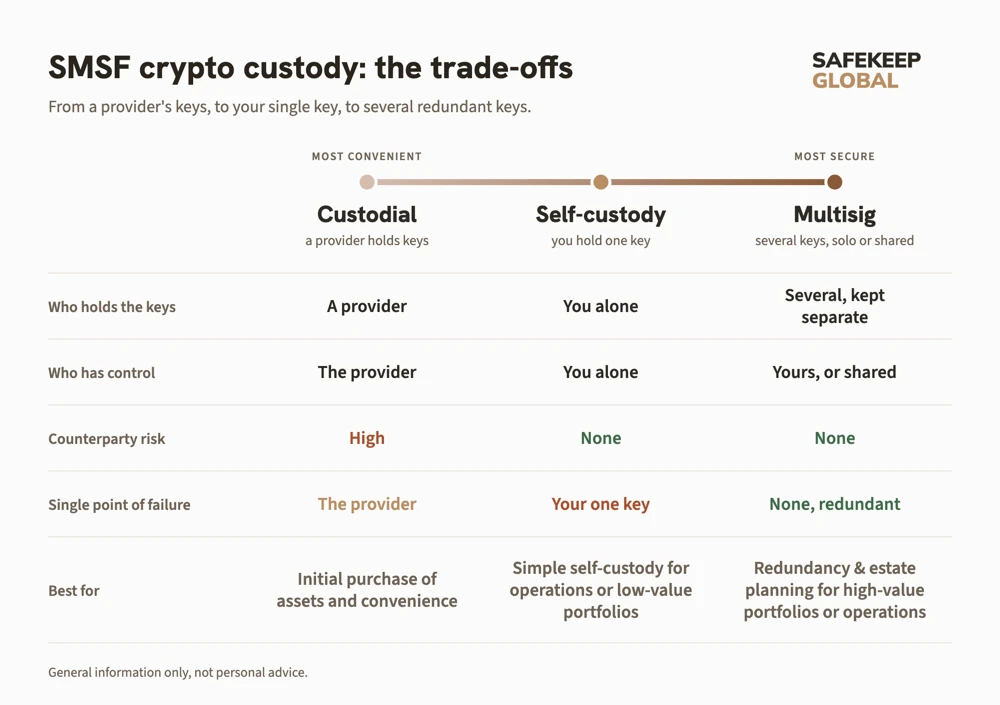
You have three main options. You can let a third party hold the keys, which is a custodian. Or you can hold the keys yourself, which is self-custody. Or you can set up a multi-sig operation so there is redundancy. Each has pros and cons. A custodian is easy, but it carries counterparty risk. Self-custody removes that risk and gives you full control, but you are the single point of failure. Multi sig requires thought and planning.
This guide walks through the options, the trade-offs, and how to keep it all defensible at audit. For the full picture of crypto inside super, see our complete guide to crypto in an SMSF.
Why your custody choice is the biggest risk decision
Your custody choice decides who really controls the fund’s crypto. This comes down to trust. Hold your own keys and no one can touch the asset without you. Leave it with a third party and you hold a claim against them, not the coins themselves. That’s the whole game, summed up in one line: not your keys, not your crypto.
Here’s a rule to live by: never store crypto long-long term on a crypto exchange. An exchange is built for trading, not safekeeping. They’re prime targets for hacks and bad management.
Now while custodians are more secure than exchanges, they still come with their own risk. When a custodian holds your crypto, you take on their risk. They can be hacked. They can freeze your account. They can go under. According to a Texas Law Review study, if a custodian fails, its customers can rank as unsecured creditors, not owners of the asset. You wait in line with everyone else.
This isn’t just theory. When FTX collapsed in 2022, creditors were eventually offered their money back. But the payout was set at the low November-2022 prices, in cash. They missed the price rise that followed. The Australian exchange Blockchain Global collapsed, and in 2025 ASIC sued its former director after customer funds were mixed with company money. Recovery, if it comes, takes years.
For your SMSF, a custodian failure hits three ways at once. Your crypto can lose value while you wait. Your access can be frozen for years. And if the company goes under, you can rank as an unsecured creditor and not get the assets back at all.
But a collapse is extreme. There’s also a lot of middle sized risks you should be aware of.
When you self-custody SMSF crypto, no third party holds your keys. No exchange, bank or counterparty can freeze, lend out, lose, or be forced to hand over your fund’s crypto. (Unless it’s frozen by the blockchain network itself for investigation, which is rare and another risk entirely). You keep direct control, while staying fully compliant. You still report every year and pay what’s owed. The protection is in how you hold the asset, not in hiding it.
Self-custody as a defence has more depth than we cover here. Read how to protect your crypto SMSF and crypto, self-custody and financial sovereignty for the full picture.
Does an SMSF’s crypto wallet have to be in the fund’s name?
Yes. Your fund’s crypto must sit in a wallet or account your SMSF owns, kept separate from any crypto you hold personally. This is the separation-of-assets rule (SIS Regulation 4.09A). Mix personal and fund crypto and you break the rule, and you make it very hard to prove what the fund actually owns.
According to the ATO, mixing personal and fund crypto is one of the most common and serious problems auditors find. Keep them fully apart, on separate wallets and separate accounts, and you clear the first hurdle.
How self-custody works (keys and seed phrases)
Self-custody rests on one thing: the private key. Whoever holds the key controls the assets. When you set up a self-custody wallet, it gives you a convenient seed phrase, a list of 12 or 24 words which can be used instead of actual private key address. That phrase becomes your master key. It can restore your whole wallet on any compatible device instantly.
So the seed phrase is the asset. Protect it like one:
- Write it on paper, or better, engrave it on metal and store it safely, stored in secret.
- Never store it online, in the cloud, in a photo, or on your phone.
- Keep more than one backup, in separate secure places.
- Test that you can restore the wallet before you rely on it.
Here’s the trade-off you accept with self-custody. There’s no reset and no support desk. Lose the seed phrase and its backups, and the crypto is gone for good. You also become the target for phishing, fake apps, and malware. Handle the keys well and self-custody SMSF crypto is very safe. Handle them badly and it’s unforgiving.
You also have to think about physical theft more than most people do. It’s like cash under a mattress. If it gets taken, it’s gone. A break-in is one risk. So are the people around you who know what you hold, which is why you keep your holdings private.
How to store crypto in an SMSF: the five main options
There are five main ways of SMSF crypto storage. Each trades convenience against control and risk.
Custodial, brokerage, or institutional
A third party holds or partially holds or controls the keys, like Binance, or Caleb and Brown. This includes exchanges, brokers, OTC desks, and modern institutional custody built on multi-party computation, or MPC.
With MPC, the key is split into shares that are computed together, so no single party ever holds the whole key. MPC is the institutional standard, run through providers like Fireblocks and BitGo, and used by Australian custodians and brokers. It’s convenient and can be insured and audit-friendly. But it’s still custodial at the end of the day. So you carry counterparty risk. You rely on the provider staying solvent and honest.
Online, or ‘hot wallet’
This is a software wallet on your phone, desktop, or browser, like Trust Wallet. You hold the keys, but they sit on a device that is connected to the internet. It’s quick and easy for small amounts and everyday use. The downside is a bigger attack surface: malware, fake apps, and phishing all target hot wallets. Generally good for operations.
Cold storage, or hardware wallet
A dedicated offline device, such as a Ledger, Trezor, or BitBox. The key lives on the device and never touches the internet. When you send crypto, the device signs the transaction inside itself, so the key stays offline even if your computer is infected.
An SMSF crypto cold wallet is the security baseline for meaningful, long-term holdings. But you still need to plug it in, and they have been known to be hacked and stolen in the past. You still need to manage the seed backup. So basically it’s the same backup as a hot wallet if you remove the wallet from the device so it’s not connected.
Cold storage still leaves you with the seed phrase to protect. The device holds the key, but you must back up the seed somewhere safe and offline, just as you would for any wallet.
Multi-signature, or multisig
Multisig uses smart contracts to lock the crypto so that more than one key is needed to move it. A common setup is two-of-three: three keys exist, and any two are needed to spend. Keys are spread across devices, locations, and sometimes a provider who holds one backup key. This removes the single point of failure and suits succession planning.
It’s a different style, not a ranking. The trade-off is higher complexity and cost. But this is the typical way companies hold secure treasury through software like Safe wallet.
Split key, or your own key sharding
Split key is a do-it-yourself version of the same idea, run by you rather than a provider. Using a scheme like Shamir Secret Sharing, you split your recovery phrase into parts, store them in separate places, and set how many parts are needed to rebuild it. No single part reveals the whole, so losing or exposing one part does not sink the fund. It’s very strong. But like all self-custody, it leans on your admin. You have to store, track, and recombine the parts without a slip.
MPC and multisig are easy to confuse. Both remove the single point of key failure, but the trust model differs. MPC splits one key into shares, usually run by the custodian, and shows as one address on the blockchain. That sits in the custodial camp. Multisig uses separate keys, often held by you or shared with a provider, and each signs on-chain. That sits in the self-custody camp. Same goal, different answer to who holds what.
Here’s a quick guide on SMSF crypto storage security vs convenience.
SMSF crypto wallets compared
Here’s how the five options compare on the things that matter for your SMSF.
| Option | Who holds the keys | Counterparty risk | Access speed | Key risk or downside | Best for |
|---|---|---|---|---|---|
| Custodial / MPC | The provider | Highest | The provider’s timetable | Control, compliance and enforcement sit with the provider, not you | Hands-off, insured |
| Hot wallet | You, on a live device | None | Instant | Online all the time, so open to hacks and theft, with a single point of failure | Small, everyday amounts |
| Cold storage | You, on an offline device | None | Instant | A single point of failure that relies entirely on you and your admin | Long-term holdings |
| Multisig | Split across 2 to 3 keys | Very low | Needs 2+ signers per move | More admin, and every move needs two or more sign-offs. That approval step is a plus for controlled operations, a friction for quick access | Larger holdings, entities, controlled operations |
| Split key | You, phrase split into parts | None | Instant, once rejoined | Very strong, but relies entirely on your admin ability | Locking down a long-term holding yourself |
The head-to-head decision between self-custody and an exchange has its own guide: self-custody vs exchange custody for an SMSF.
How to choose the right wallet type for your SMSF
You’ll start with an exchange account to buy the crypto. From there you need to decide where you want to move your assets into SMSF crypto storage. Start with asking yourself, is this crypto for operations or for investment?
- Operations means you move money in and out, and you need a workflow to approve transfers regularly. Favour quick, controlled access, like a hot wallet, or an MPC or multisig setup with a clear approval process.
- Investment means you lock it down for the long term. You don’t need to look at it every day or move it quickly. Favour deep self-custody, like cold storage or a split key.
Then weigh five more things into your decision:
- Size of the holding. Small, active amounts suit a hot wallet. Larger, long-term holdings suit an SMSF crypto cold wallet or multisig.
- Technical comfort. Self-custody puts the keys in your hands. If that worries you, a professional custodian may fit better.
- Counterparty tolerance. A custodian is convenient but you carry its risk. Self-custody removes that.
- Cost. An SMSF crypto cold wallet and multisig cost money. A custodian charges fees.
- Succession. If you need a clean handover on death or incapacity, multisig or a professional custodian makes it easier.
How to self-custody SMSF crypto and pass the audit
Self-custody is allowed in an SMSF. The catch is proof ownership. A wallet address carries no name, so you have to show, on paper, that your fund owns it and controls it. Get this right and the audit is straightforward.
Here’s how the audit works each year. Before you lodge the fund’s annual return, an independent, ASIC-registered SMSF auditor checks the fund’s accounts and its compliance. For crypto, the auditor confirms three things: the assets exist, the fund owns them, and they’re valued correctly at 30 June.
According to the ATO, if the auditor can’t verify all three, they must qualify the fund’s audit report and may report the breach to the ATO. So your job is simple: hand them evidence they can check for themselves.
And here’s what catches people out. You can’t just hand this to your accountant and forget it. Your accountant can prepare the paperwork, the strategy, the resolutions, the valuation write-up. But a self-custody wallet gives them no statement to download.
Only you, the key-holder, can produce the evidence that needs the keys: the test transfer, the on-chain balance, the proof of control. The auditor can’t make it for you either, because they’re independent and only check your evidence. Self-custody puts that job in your hands. That’s the trade-off for holding your own keys.
How to prove your fund owns a nameless wallet
You build an evidence trail. Here’s what each piece looks like in practice:
-
A declaration of trust. A written document where the trustee declares it holds the wallet, and the crypto in it, on behalf of the SMSF. You don’t need a lawyer to draft one from scratch. A proper template from an SMSF deed provider or lawyer works, as long as you complete it correctly and the trustees sign and date it.
It must name the fund, the trustees, and the wallet’s public address. That address is the link between the paper and the assets on the chain, so a declaration that just says “our crypto” won’t do. Get the wording right, because it’s the document that ties a nameless wallet to your fund, and the first thing an auditor asks for. For a large holding, a quick legal review is cheap insurance.
-
The funding trail. Show money flow: out of the fund’s bank account, into an exchange account in the fund’s name, and on to the fund’s wallet. The bank statement, the exchange record, and the on-chain transaction all line up. It proves the fund, not you, paid for the crypto.
-
A test transfer that proves control. Send a small, set amount from the fund’s wallet and record it. Only the key-holder can send, so it proves the fund controls that wallet. This is the practical step, and there’s a how-to below.
-
A trustee resolution. Record the decision to buy the crypto and hold it in that wallet in a signed trustee resolution. Date it and keep it.
Do not confuse three separate documents. The trustee declaration you signed at setup covers your duties, not the wallet. The Declaration of Trust above is the one that proves the wallet is the fund’s. The yearly valuation resolution, further down, records the 30 June holding. Together they make the fund’s ownership provable, even though the wallet carries no name.
According to the ATO, where an asset cannot be titled in the fund’s name, you should document your fund’s ownership with a declaration of trust, and the auditor must see evidence it is held for the fund. For crypto, that is the stack above.
The practical way to prove control: a test transfer
A test transfer is the simplest, most reliable way to prove the fund controls its wallet. Only someone with the private key can send from it. So a recorded send from the fund’s wallet is hard proof of control. It works for any coin and any wallet.
Here’s how:
- Pick a small, specific amount, say $5 of USDT or another asset you hold.
- Send it from the fund’s wallet to another address the fund controls, like a second fund wallet or the fund’s own exchange account.
- Record the transfer.
To prove ownership for the SMSF, record and keep six things:
- The sending address (the fund’s wallet).
- The receiving address (also the fund’s).
- The amount sent.
- The date and time.
- The transaction ID, the unique reference for that transfer.
- A blockchain-explorer link to the transaction, so anyone can re-confirm it.
Put these in a trustee resolution, next to the declaration of trust that names the wallet address. Now the chain is complete. The deed says the fund owns the address, and the test transfer proves the fund controls it. An auditor can re-check the whole thing on-chain, any time.
Two things to note. The transfer costs a small network fee. And it’s a real transaction on the blockchain, so record it like any other, even though the amount is tiny.
Valuing the wallet at 30 June
A self-custody wallet sends you no statement, so you build the valuation yourself. And a screenshot on its own is not enough. According to the ATO, holding statements or summaries alone do not confirm market value, and the audit standard rates a screenshot, which you can edit, below independent evidence.
There is no special “deed of value” to sign. What you produce is a trustee resolution, backed by an evidence pack. Five parts:
- The on-chain balance. Look up the wallet address on a blockchain explorer at the point closest to 30 June, and record the coins and amounts. This is independent proof the coins exist.
- Proof of control. The test transfer from above, with its records.
- The 30 June price. Use the 30 June closing price in Australian dollars from a reputable exchange that publishes history. This is the source the ATO accepts. Use the same exchange every year.
- A dated screenshot of the wallet balance, as backup only.
- The calculation. Coins times the 30 June price, per coin, added up to a total.
You then sign a resolution recording the wallet address, the coins held, the price source, the per-coin price, the calculation, and the total value. You’re responsible for the valuation, but your accountant or administrator usually prepares it for you to sign. It’s the fund’s own document, in the fund’s name and signed by the trustees, not a branded certificate on the accountant’s letterhead. And the one party who cannot do it is the auditor. They check your valuation, they don’t set it.
If your fund holds crypto through an exchange or custodian instead, the auditor asks the custodian for a Type 2 report. A self-custody wallet has no custodian, so the explorer-and-price pack does that job.
What you cannot do
Some lines you don’t cross:
- No personal use of the fund’s crypto. That breaks the sole purpose test (SIS Act s62).
- No moving your own personal coins into the fund. Crypto is not an allowed related-party asset (SIS Act s66), so the fund must buy its own.
- No personal wallet or account for fund crypto, and no holding the keys “personally” outside the fund.
- No mixing personal and fund coins, even on the same device.
Succession and key loss
Plan for the day a key-holder is gone. If one person holds the only key, their death or incapacity can lock your fund out for good. Build in a recovery plan: multisig or a split backup, sealed instructions kept separately from the seed, and the crypto written into the fund’s succession plan. There’s more on this in what happens to your SMSF crypto when you die and how to keep your SMSF crypto safe from hackers.
Your document checklist
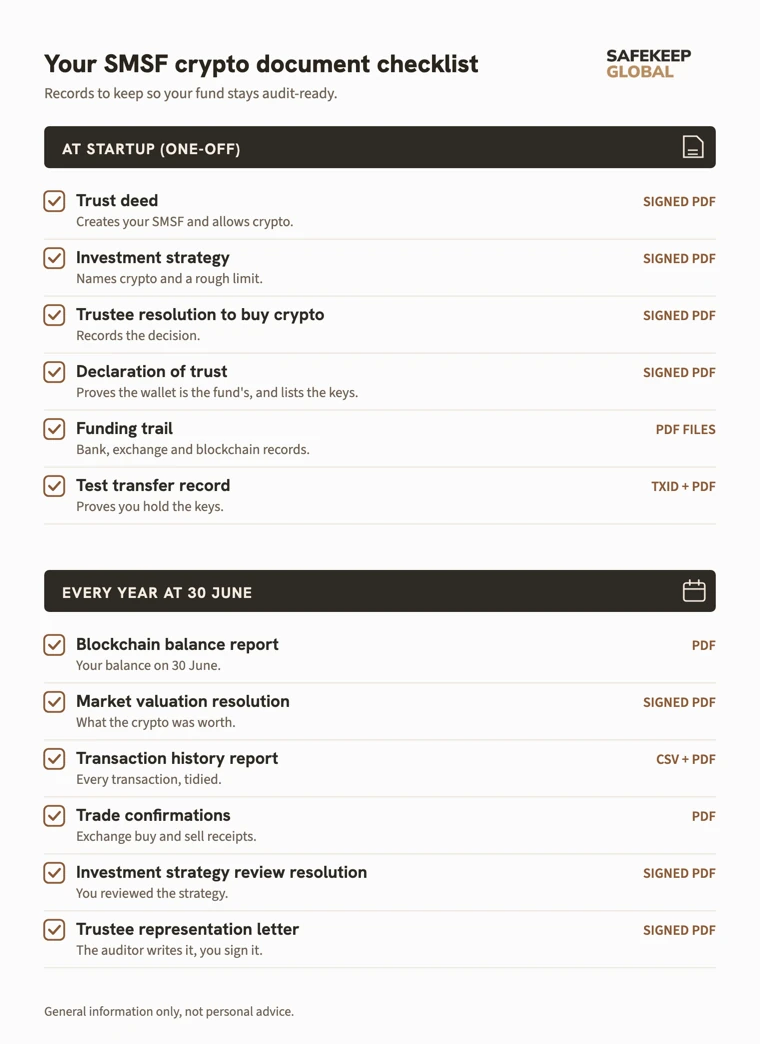
Almost every item here is a signed PDF that you or your accountant produce. Two quick definitions first, because the names trip people up:
- A trust deed is the document that creates your SMSF and sets its rules. Your SMSF provider or a lawyer makes it when you start the fund.
- A trustee resolution is a document that records a decision the trustees made, dated and signed. Some accountants call it “trustee minutes”. It’s the same thing.
When you set up self-custody (one-off)
| Document | What it is | Who creates it | Who signs it | Format |
|---|---|---|---|---|
| Trust Deed | Creates your SMSF and allows it to hold crypto | Your SMSF provider or a lawyer | All trustees | Signed PDF |
| Investment Strategy | Sets out how the fund invests, names crypto and a rough limit | You, with your accountant | All trustees | Signed PDF |
| Trustee Resolution to Buy Crypto | Records your decision to buy and hold crypto | You, from an accountant template | All trustees | Signed PDF |
| Declaration of Trust | States the wallet, named by its public address, belongs to the fund and not to you personally, and lists the device, who holds the keys, and where the seed-phrase backup is kept | You, from a template, or a lawyer for large holdings | The person the wallet is registered under, plus all trustees | Signed PDF |
| Funding Trail (three saved files) | Proof the money came from the fund: the fund bank statement, the exchange purchase receipt, and the blockchain record of the coins arriving in your wallet | The bank, the exchange and the blockchain. You download and save them | No signature needed | PDF files |
| Test Transfer Record | A record of a small test send that proves you hold the keys: the transaction ID and a saved blockchain confirmation | You | Recorded inside the Trustee Resolution | Transaction ID plus a PDF from the blockchain website |
The Declaration of Trust proves the fund owns the wallet, but it can’t do that on its own. It’s a document you sign yourself, and auditors treat self-signed documents as the weakest kind of proof. The Funding Trail and the Test Transfer are what back it up. Together the three show the fund both owns and controls the wallet.
Every year for the audit (each 30 June)
| Document | What it is | Who creates it | Who signs it | Format |
|---|---|---|---|---|
| Blockchain Balance Report | A PDF you save from the blockchain website, showing your wallet address and its balance on 30 June | You save it from the blockchain explorer, like Etherscan | No signature needed | |
| Market Valuation Resolution | Records what the crypto was worth on 30 June: the coin, the quantity, the price, which exchange the price came from, the total in Australian dollars, and the date | Your accountant works out the figures, you record them | All trustees | Signed PDF |
| Transaction History Report | Lists every transaction for the year from your exchange and wallet, tidied by crypto tax software like Koinly or Syla | You export it, your accountant or the software tidies it | No signature needed | CSV plus a PDF report |
| Trade Confirmations | The buy and sell receipts the exchange gives you for each trade | The exchange | No signature needed | |
| Investment Strategy Review Resolution | Records that you reviewed the investment strategy this year, even if nothing changed | You | All trustees | Signed PDF |
| Trustee Representation Letter | Confirms everything you told the auditor is true. The auditor writes it, you sign it | The auditor | All trustees | Signed letter (PDF) |
Keep the setup documents on file. You only redo them if the wallet or the fund changes.
The most common self-custody mistakes
Two kinds of mistake sink SMSF self-custody. One fails the audit. The other loses the coins.
Compliance mistakes (fail the audit):
- Holding the fund’s crypto in a personal wallet or account.
- Mixing personal and fund coins, even on one device.
- No ownership declaration for the wallet.
- A missing or unsupported 30 June valuation.
- Weak or incomplete records.
Operational mistakes (lose the coins):
- Losing or forgetting the seed phrase, with no backup.
- Storing or entering the seed in the wrong place: online, in the cloud, in a photo, or on a phishing site.
- Setting up multisig badly: all the keys in one location, or a recovery path you never tested.
- Not checking the destination address before you send. A transfer to the wrong address is gone for good, so watch for malware that swaps the address you paste.
Where to go from here
Custody is the decision that protects your fund’s crypto. Store it in your fund’s name, choose the option that fits your holding and your comfort, and keep the records that prove ownership and value. Do that, and your crypto is both safe and audit-ready.
Want help holding your fund’s crypto the right way? Talk to our SMSF crypto accountants, or get compliance and audit support.
SMSF crypto wallet FAQs
Does an SMSF's crypto wallet have to be in the fund's name?
Yes. Under separation-of-assets rules, the wallet or account must be the fund's, kept apart from any personal crypto. Mixing them can make the fund non-complying and makes ownership hard to prove at audit.
Can my SMSF use a cold wallet (hardware wallet)?
Yes. A hardware wallet like a Ledger, Trezor or BitBox is allowed, as long as it is bought and used only for the fund, and you can prove the fund owns it. Never share the device with your personal crypto.
How do I prove the SMSF owns the wallet?
A wallet address holds no name. You prove ownership with a declaration of trust that names the wallet address, the funding trail from the fund's bank account, and a small recorded test transfer from the wallet to show the fund controls the keys.
Can I keep my SMSF crypto on the exchange?
You can, if the account is in the fund's name. But the exchange holds the keys, so you carry counterparty risk: a freeze, hack or collapse can lock or lose the fund's crypto. Many trustees move to self-custody for that reason.
What happens if the trustee dies or loses the seed phrase?
If the only key is lost, the crypto is gone for good. Plan for it: use multisig or a recovery setup, store the seed backup safely and separately, leave sealed instructions, and build the crypto into the fund's succession plan.
Keep reading

Sources
Primary sources for the facts and figures in this guide, current as at July 2026.
Australian Taxation Office
Legislation